Why You Get Tired of Protein Before You Hit Your Target, and What Fixes It
Quick Answer: Getting sick of protein is sensory-specific satiety doing its job: the appetite system dials down desire for flavors and textures you have had repeatedly, and it does it fastest for savory, umami-heavy foods — which is exactly what most protein staples are. Protein is also the most filling macronutrient per calorie, so you are pushing the food you are least hungry for through the appetite channel that saturates first. The fix is not more willpower; it is rotating across flavor channels — hot-savory, cold-savory, sweet, and drinkable — so no single channel wears out.
Once you structure the week this way, the last thirty grams stop being a nightly negotiation.

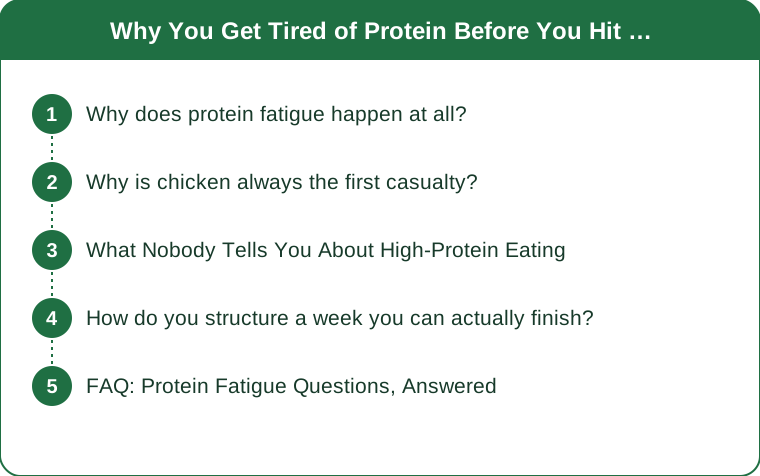
Why does protein fatigue happen at all?
Because your appetite is not one dial — it is a set of channels, and they tire independently.
Sensory-specific satiety is the mechanism: as you eat a food, your desire for that specific flavor-texture combination drops while your interest in different ones stays intact. It is why dessert fits after a full dinner, and why the fourth day of leftover chili defeats people who loved it on day one. The system exists to push you toward dietary variety, and it does not care that you have a macro target.
Protein staples get hit hardest for two stacked reasons. First, they cluster in one sensory lane: savory, umami-dense, chewy. Chicken, beef, eggs, fish, and tofu prepared normally all knock on the same door, so they share one fatigue meter rather than each having their own. Second, protein is the most satiating macronutrient per calorie — excellent news for staying full, inconvenient news when you are trying to eat more of it. You are asking the food that shuts appetite down soonest to arrive in the largest portions.
Add the modern habit of eating the same prepped meal daily and the outcome is predictable: somewhere in week two, the exact meal that worked becomes the meal you cannot face. People read this as motivation failing. It is a functioning satiety system meeting a repetitive menu, and the solution is engineering, not grit.
Why is chicken always the first casualty?
Because everything about how we use chicken accelerates the fatigue.
It starts lean, which means little fat to carry flavor and moisture, so its baseline sensory interest is low. It gets batch-cooked, which commits you to five consecutive appearances of one seasoning decision. And it gets reheated — which is where the underrated chemistry kicks in.
Reheated meat develops what food scientists call warmed-over flavor: fats oxidize in cooked meat within a day or two of storage, producing stale, cardboard-adjacent notes that fresh meat does not have. Poultry is especially prone. So day-four chicken is not just boring — it genuinely tastes worse than day-one chicken did, and your satiety system, already tired of the savory channel, gets handed a degraded version of the thing it was tired of.
The practical countermeasures are specific. Batch-cook the protein plainly and add the flavor at serving time, so five portions can become five different meals — one goes peanut-sauce, one goes lemon-herb, one goes buffalo, one lands on a salad, one disappears into soup. Reheat gently with added moisture, or better, serve some portions cold on purpose, where warmed-over flavor reads far weaker. And stop letting one protein carry the whole week: the meter that matters is per-channel, so eggs at breakfast, yogurt midday, and chicken at dinner draws on three meters instead of hammering one.
None of this adds cooking time. It relocates the seasoning decision from Sunday to the moment you eat, which is exactly where variety is cheapest.

What Nobody Tells You About High-Protein Eating
You are probably not tired of protein — you are tired of one cooking method. The person burned out on grilled chicken is rarely burned out on chicken soup, cold chicken salad with grapes, or chicken tinga. Method changes texture, temperature, and aroma at once, which resets more of the satiety math than swapping proteins does.
Sweet protein does not touch the savory meter. Greek yogurt with fruit, cottage cheese blended smooth with berries, a milk-based shake — these route through an entirely different sensory channel, which is why they stay easy when dinner proteins have become a chore. The people who hit high targets comfortably almost all run a sweet-protein lane on the side.
Temperature is a flavor variable, not an afterthought. The same chicken reads completely different cold over greens than hot off a pan — colder foods also present less aroma, which quiets the warmed-over problem. In late-summer heat this is free: chilled proteins fit August in a way another hot plate does not.
Sauce is infrastructure, not cheating. A fifty-calorie spoon of chimichurri, salsa verde, or yogurt-dill that gets three hundred calories of protein eaten pleasantly is doing more for the week than its macros suggest. Budget for sauces the way you budget for the protein itself.
The last thirty grams are a psychology problem, not a hunger problem. By evening the savory meter is spent, which is why the gap is best closed by the sweet or drinkable lane — and why staring down one more chicken breast at 9pm keeps failing.
How do you structure a week you can actually finish?
Around four channels, rotated so none of them saturates.
Hot-savory is dinner as usual — the roasts, stir-fries, and grills. It needs no help beyond the serve-time seasoning trick.
Cold-savory covers lunches without triggering reheat fatigue: chicken or tuna salads, deli-style plates, cold noodle bowls with edamame, hard-boiled eggs. Prep proteins plain; dress cold at assembly.
Sweet is the yogurt-cottage-cheese-fruit lane, best deployed at breakfast and as the evening gap-closer.
Drinkable is the shake — the zero-chewing channel for training days and rushed mornings. One a day is a tool; three a day means the solid-food channels need repair.
A week that finishes itself looks like: two or three base proteins cooked plainly in bulk, a shelf of serve-time sauces, breakfast running the sweet lane, lunch running cold-savory, dinner running hot-savory with the seasoning rotated daily, and the drinkable lane on call. Every channel gets touched; no channel gets hammered two meals in a row.
And one seasonal note while the heat lasts: appetite genuinely runs lower in hot weather, so let August lean on the cold and drinkable lanes without guilt — chilled shrimp, yogurt bowls, cold sesame chicken. The hot-savory channel will be back on duty by the first cool week of September, refreshed from the time off.
Targets themselves are individual — training, age, and goals move them — so treat this as structure for whatever number you and your own research or practitioner have settled on.
FAQ: Protein Fatigue Questions, Answered
Is a protein shake every day fine, or is that a crutch?
Daily is fine as one channel among four. The shake earns its place on training days and compressed mornings; it becomes a problem only when it substitutes for ever solving the solid-food rotation, because liquid calories also satisfy less per calorie.
Does it matter if I spread protein out or eat it all at dinner?
Spreading it across three or four meals is the practical winner — partly for the usual physiological arguments, but mostly because distribution is what makes the target achievable. Ninety grams at dinner runs headfirst into the satiety wall this whole article is about.
I am plant-based — does the rotation idea still apply?
Even more so, since legume-forward eating can get texturally repetitive fast. Rotate the format, not just the bean: crispy roasted chickpeas, blended hummus plates, tofu that is silken in soup one day and pressed-and-seared the next, tempeh crumbled versus sliced. Same channel logic, same result.
What about days when appetite just is not there?
Go liquid and cold first — a shake and a yogurt bowl can quietly bank fifty grams before the appetite question even gets asked. Then let the remaining meals be small and unambitious. A lower-protein day inside a well-structured week is noise, not failure.
TL;DR:
- Protein fatigue is sensory-specific satiety: desire drops for repeated flavors, fastest for savory ones — and protein is also the most filling macro per calorie.
- Chicken falls first because lean, batch-cooked, reheated meat stacks every accelerant, including genuine warmed-over flavor from fat oxidation.
- Rotate four channels — hot-savory, cold-savory, sweet, drinkable — and season at serve time, not on prep day.
- Close the evening gap with the sweet or drinkable lane; stop fighting the savory meter after it is spent.
This week, cook the protein plain, buy three sauces, and put yogurt at breakfast. The target stops shrinking the moment the menu stops repeating.
Keep Reading
This article is for general informational purposes only and is not medical advice. Always consult a qualified health professional for guidance specific to you.