Why Eating Out Quietly Costs You Twenty Grams of Protein
Quick Answer: Restaurant portions are built around carbohydrate and fat, because those are cheap, filling, and carry flavour. A typical restaurant main delivers 15 to 25g of protein against 700 to 1,100 calories, where the same calories at home would usually deliver 35 to 45g. Eat out twice a week and you are quietly running a deficit of 40 to 50g against your weekly target while eating more calories, not fewer. The fix is ordering a protein addition, not choosing a healthier-sounding dish.
This is why people who track carefully at home still miss their target most weeks.
The missing protein is not in the meals you logged. It is in the ones you did not.

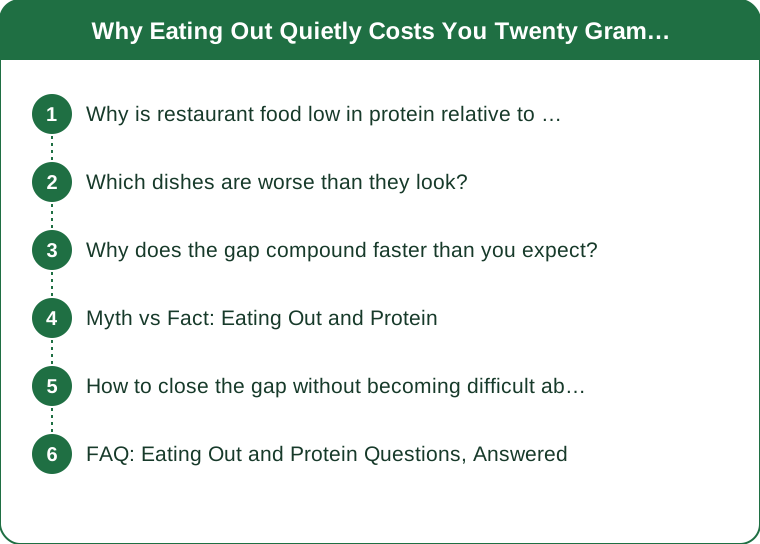
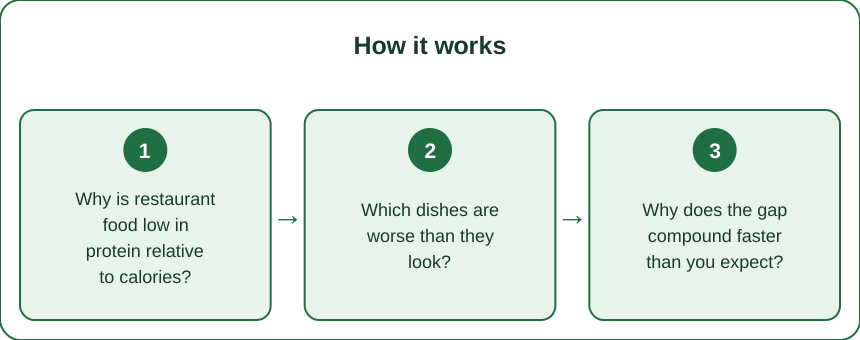
Why is restaurant food low in protein relative to calories?
Because protein is the most expensive thing on the plate.
A restaurant’s margin depends on the cost of ingredients per portion. Rice, pasta, potatoes, bread, oil, and butter cost very little and do enormous work — they fill the plate, carry flavour, and make the meal feel generous. Meat, fish, eggs, and dairy protein cost several times more per gram of nutrition delivered.
So the economically rational plate is one where the protein is the garnish and the starch is the substance. That is not a criticism; it is why eating out is affordable at all.
The result in numbers is stark. A restaurant pasta dish might contain 60 to 90g of pasta protein-poor carbohydrate, a generous amount of oil or cream, and 80 to 100g of chicken — around 20 to 25g of protein in a 900-calorie meal. Cook the same dish at home with the portion of chicken you would normally use and you would land closer to 40g in fewer calories.
The calories arrive. The protein does not.
Which dishes are worse than they look?
Usually the ones that sound sensible.
Consistently protein-poor:
- Pasta and risotto dishes — often 15 to 22g despite 800 to 1,100 calories
- Salads with a small protein topping — a healthy-sounding option that frequently delivers 12 to 18g
- Grain bowls and buddha bowls — heavy on grains and roasted vegetables, light on the protein element
- Soups and stews served with bread — the protein is diluted through a large liquid volume
- Most vegetarian mains — vegetable-forward rather than legume-forward, so often under 15g
Consistently better:
- A plain grilled or roasted protein with sides — usually 35 to 50g
- Steak, fish fillet, chicken breast dishes where the protein is the named item
- Greek, Middle Eastern, and Korean mains built around grilled meat or pulses
- Breakfast dishes with eggs — three eggs plus a side is a genuinely solid 25 to 30g
The pattern is simple: if the protein is in the dish name, you get some. If it is in the description, you get a garnish.
Why does the gap compound faster than you expect?
Because it is a daily target with no carry-over.
Protein does not bank. Eating 130g on Monday does not cover a 70g Tuesday, because muscle protein synthesis responds to what is available on the day, in reasonably sized doses. A day that lands 60g short is a day that is short, and no amount of catching up on Wednesday retrieves it.
Run the arithmetic on a fairly ordinary week. Two dinners out and one lunch out, each 20g below what the same calories at home would have delivered, is 60g of shortfall. That is roughly half a day’s target for many active women, gone, in a week where you felt like you ate plenty.
And because those meals are calorie-dense, you often eat less elsewhere that day to compensate — which removes protein from the meals that were actually delivering it. The restaurant meal costs you protein twice: once in what it did not contain, and once in what it displaced.

Myth vs Fact: Eating Out and Protein
Myth: Choosing the healthiest-sounding option solves it.
Fact: The healthy-sounding options — salads, grain bowls, vegetable pasta — are usually the lowest protein items on the menu. The steak is the higher-protein choice almost every time.
Myth: You can eyeball restaurant protein portions accurately.
Fact: Almost nobody can. Restaurant chicken portions are commonly 80 to 120g cooked, which most people estimate as 150 to 200g. Cooked meat also looks larger than it is because it is often sliced and fanned out.
Myth: A protein shake afterwards fixes the day.
Fact: It genuinely helps, and it is the simplest fix available. The reason it is not a complete answer is that it adds calories to an already large day, which is fine occasionally and awkward as a routine.
Myth: This only matters if you are trying to build muscle.
Fact: It matters more in a calorie deficit, where adequate protein is what protects lean mass. The people who most need the protein are often the ones eating out and eating less at home to compensate.
How to close the gap without becoming difficult about it
Four moves, in order of how easy they are.
1. Add a protein, do not swap a dish. Almost every restaurant will add an egg, a chicken breast, extra halloumi, prawns, or a side of meat for a few pounds. This is the single highest-return habit and it takes one sentence.
2. Order the dish where the protein is the headline. Grilled fish with sides beats a fish pasta every time, for both protein and satisfaction.
3. Front-load the day. If you know dinner is out, put 40g into breakfast and 40g into lunch. This is far more reliable than trying to fix it afterwards.
4. Start with a protein-forward starter. Prawns, chicken skewers, edamame, a small cheese plate, or soup with pulses adds 10 to 20g before the main arrives.
A reasonable target when eating out is simply 30g from the meal, achieved by any combination of the above. That turns a 20g shortfall into a rounding error, and it does not require reading a nutrition panel or interrogating a server.
FAQ: Eating Out and Protein Questions, Answered
How much protein do I actually need per day?
Commonly cited targets for active adults sit around 1.6 to 2.2g per kilogram of bodyweight, which for a 65kg person is roughly 104 to 143g. Distribution matters too — aiming for 25 to 40g per meal rather than one large hit is more effective for muscle protein synthesis.
Are takeaways worse than restaurants?
Usually yes, and for the same reason amplified. Takeaway margins are thinner and starch is cheaper, so the protein-to-calorie ratio tends to be worse still. Grilled options and anything built on a named meat are the exceptions.
What is the best restaurant meal for protein?
Grilled fish or steak with vegetables and a starch side, which routinely lands 40 to 55g. Breakfast out with eggs is the other strong option and is usually overlooked.
This is general information, not personalised nutrition advice. If you have specific medical or dietary needs, speak to a registered dietitian.
TL;DR:
- Restaurant plates are built on cheap carbohydrate and fat, so protein is structurally low
- A typical main delivers 15 to 25g against 700 to 1,100 calories
- Healthy-sounding dishes — salads, grain bowls, pasta — are usually the lowest-protein options
- Protein does not bank, so each short day stays short
- Add a protein to the order and front-load the rest of the day
You do not need to stop eating out, and you do not need to interrogate the kitchen. One extra egg or chicken breast on the order closes almost the entire gap, and it is the difference between a week that hits your target and a week that quietly misses it three times.
Keep Reading
This article is for general informational purposes only and is not medical advice. Always consult a qualified health professional for guidance specific to you.