Why Your Protein Target Collapses the Week You Get Sick
Quick Answer: Illness raises protein requirements — often by 20 to 50% during fever or infection — at the same time as it suppresses appetite and dulls taste. Most people drop from around 1.6g per kg to under 0.8g per kg for a week. The fix is not to force normal meals; it is to shift to liquid, cool and savoury protein sources and accept that hitting 80% of target beats hitting 40% of it.
Day one you feel it coming and eat almost normally.
Day two nothing sounds good, and you have a piece of toast for lunch because it is the only thing you can face.
By day four you are through the worst of it but you feel weaker than the illness alone should explain — and you have not eaten meaningful protein since Sunday.

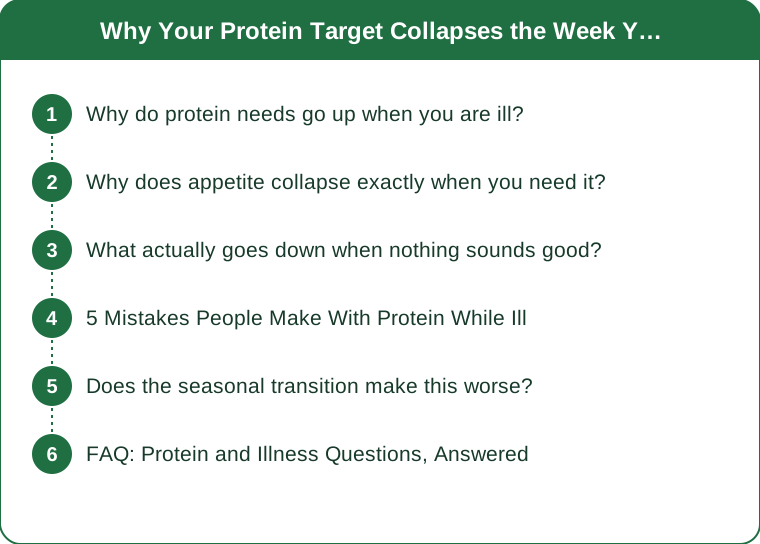
Why do protein needs go up when you are ill?
Because your immune system is a construction project, and it builds out of amino acids.
Antibodies are proteins. So are the cytokines that coordinate an immune response, and the acute-phase proteins your liver ramps up production of during infection. All of it draws from your amino acid pool.
Fever raises metabolic rate. Metabolic rate rises roughly 10 to 13% per degree Celsius of fever. Higher turnover means more protein used, not less.
Muscle becomes a donor. If dietary protein does not cover demand, the body breaks down skeletal muscle to supply amino acids. This is why a week in bed costs noticeably more muscle than a week of simply not training.
Estimates vary by illness severity, but a realistic figure for a common respiratory infection is a 20 to 50% increase over your normal requirement. Someone normally eating 100g a day may genuinely need 120 to 140g.
The cruel part is that this is precisely the week you can least face a chicken breast.
Why does appetite collapse exactly when you need it?
It is a deliberate biological trade-off, not a malfunction.
Inflammatory signalling molecules — particularly the interleukins involved in fever — act on appetite regulation in the brain and actively suppress hunger. In evolutionary terms, an animal that stops foraging while sick conserves energy and avoids predators.
Three additional mechanics stack on top:
- Taste and smell dull. Congestion removes most of flavour perception, and food you cannot taste is food you do not want.
- Protein foods become least appealing first. Meat and eggs are commonly the first things to become unappetising during illness. Sweet and starchy foods hold their appeal longest.
- Fatigue removes the will to cook. Cooking is the barrier, not eating.
Understanding this matters because it changes the strategy: you are not going to out-discipline an appetite suppression system. You have to route around it.
What actually goes down when nothing sounds good?
Liquid, cool and savoury. In that order of importance.
Liquid beats solid. Drinking is easier than chewing when you are exhausted and your throat hurts. A shake or a soup delivers 25 to 30g without the effort of a meal.
Cool beats hot for some, warm for others — but cold foods carry less aroma, which is genuinely helpful when smell is the thing making food unappealing. Chilled Greek yoghurt often works when nothing hot does.
Savoury beats sweet after day two. Most people can face sweet protein for a day and then hit a wall.
Practical options, all around 20 to 30g:
- A protein shake blended with milk — 30g, needs no cooking.
- Greek yoghurt with honey — 20g per 200g pot, cold and easy.
- Chicken or bone-broth soup with added shredded chicken — 25g, warm and salty.
- Cottage cheese — 25g per 200g, cold and neutral.
- Eggs scrambled soft — 12g for two, when you can face them.
The target during illness: three of these a day. That is 60 to 90g, which is not your normal target, but it is dramatically better than toast.

5 Mistakes People Make With Protein While Ill
1. Waiting until appetite returns. By then you have lost a week of intake. Something is always better than nothing.
2. Trying to eat normal meals. A full plate is intimidating when you have no appetite, and an intimidating plate gets abandoned. Small and frequent wins.
3. Drinking only sweet things. Sports drinks and juice provide fluid and carbohydrate but essentially no protein, and they blunt appetite for anything else.
4. Forgetting fluid entirely. Dehydration worsens fatigue and makes everything harder. Protein and fluid together — shakes and soups — solve two problems at once.
5. Resuming full training too fast to make up for it. The muscle you lost comes back faster than you fear, but only if you eat while it does. The third one on this list catches almost everyone — sweet drinks feel like nutrition and quietly displace real intake.
Does the seasonal transition make this worse?
It does, and this is why September and October matter.
The first cold of the season usually lands two to four weeks after routines change — schools return, indoor gatherings resume, and ventilation drops. For most people that means the first illness of autumn arrives just as training volume is picking back up after summer.
Two specific autumn factors:
- Appetite is already shifting. Cooler weather moves eating toward warm, carbohydrate-heavy comfort food, which is naturally lower in protein per calorie than summer eating. Illness on top of that shift compounds the deficit.
- Less daylight, more fatigue. Recovery from illness is slower when sleep quality drops, and shortening days disrupt sleep timing for a lot of people.
The practical preparation: keep two or three no-cook protein options in the house permanently from September onwards. A tub of protein powder, long-life Greek yoghurt pots and tinned soup you can add chicken to cost very little and mean the decision is already made when you cannot make decisions.
FAQ: Protein and Illness Questions, Answered
Should I take extra protein supplements when sick?
A shake is a practical delivery method, not a special remedy. There is no benefit to exceeding your adjusted requirement, and very high intakes can worsen nausea. Aim for adequate, not maximal.
How long until I regain what I lost?
For a typical week-long illness, most people restore strength within one to three weeks of normal eating and training. Come back at about 70% of your previous training load for the first week.
Is loss of appetite ever a reason to see someone?
Yes — appetite loss lasting more than about a week, an inability to keep fluids down, or unintended weight loss beyond a couple of kilos deserves medical attention.
This is general information, not medical advice. If you have a chronic condition, kidney disease, or are recovering from surgery, protein targets during illness should be set with your doctor or dietitian.
TL;DR:
- Illness raises protein needs by roughly 20 to 50% while simultaneously suppressing appetite — the worst possible combination.
- Antibodies, cytokines and fever-driven metabolic rate all draw on your amino acid pool, and muscle becomes the donor if food does not cover it.
- Route around appetite rather than fighting it: liquid, cool, savoury, three servings of 20 to 30g a day.
- Stock no-cook protein options from September so the decision is already made when you are too tired to make it.
You are not going to eat perfectly with a fever, and you do not need to. Getting two thirds of the way there is the difference between losing a week and losing a month.
Keep Reading
This article is for general informational purposes only and is not medical advice. Always consult a qualified health professional for guidance specific to you.