Why Two People Eating the Same Daily Protein Total Can Get Completely Different Results
Quick Answer: Total protein intake is only one variable — training stimulus, protein source quality, distribution across the day, and total calorie balance all interact with that number, so identical gram totals can produce different results if any of those other factors differ.
You and a friend both hit 100 grams of protein a day like clockwork, but her results are noticeably ahead of yours, and the gram total alone can’t explain why.

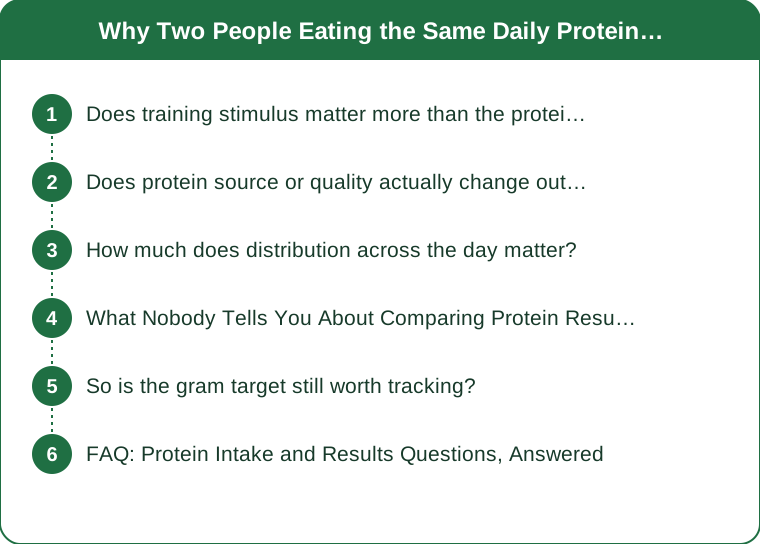
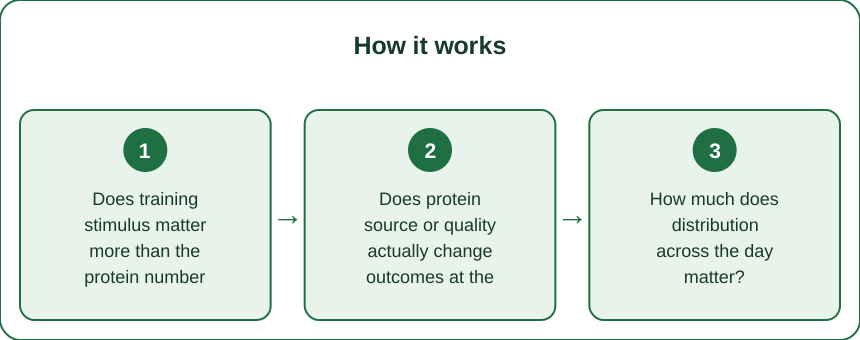
Does training stimulus matter more than the protein number itself?
Protein without adequate resistance training stimulus has limited ability to build muscle — it can support maintenance and recovery, but the actual growth signal comes primarily from progressive training load. If one person is lifting with progressive overload and the other isn’t, the same protein total will produce very different outcomes because the underlying stimulus differs.
This is the single most commonly overlooked variable when people compare protein intake results — the protein and the training are a combined system, not separate inputs.
Does protein source or quality actually change outcomes at the same gram total?
To a meaningful degree, yes — complete proteins with a full essential amino acid profile (most animal sources, soy, and a few select plant combinations) support muscle protein synthesis more efficiently gram-for-gram than incomplete sources eaten in isolation. Two people hitting 100g from very different source mixes aren’t necessarily getting equivalent usable protein.
How much does distribution across the day matter?
Getting all 100 grams in one or two large meals versus spread across 3-4 meals changes how much of that protein your body can actively use for muscle protein synthesis at any given time — there’s a practical ceiling (commonly cited around 30-40g) to how much protein triggers maximal synthesis response per sitting, so heavily lopsided distribution can waste some of the total.

What Nobody Tells You About Comparing Protein Results
Total daily calories matter enormously and often get ignored in these comparisons — the same protein total in a calorie deficit versus a slight surplus produces very different body composition outcomes, since protein’s job (supporting muscle) works differently depending on whether the body has adequate overall energy to build with.
Also underrated: sleep and recovery quality change how effectively the same protein and training translate into visible results — under-recovered training blunts the entire process regardless of nutrition being dialed in.
So is the gram target still worth tracking?
Yes — total protein remains one of the most useful single numbers to track, it’s just not sufficient alone. Treat it as one input alongside training consistency, distribution, and overall calorie context rather than the single explanatory variable for results.
FAQ: Protein Intake and Results Questions, Answered
Is there a point where more protein stops helping?
Most research suggests benefits plateau somewhere around 1.6-2.2g per kg of bodyweight for active individuals — well beyond that, extra protein mostly just adds calories rather than additional muscle-building benefit.
Does timing protein right after a workout matter as much as people say?
Less than commonly believed — total daily intake and consistent distribution across the day matter more than a narrow post-workout “window.”
Can two people with identical protein and training still get different results?
Yes — genetics, sleep, stress, and hormonal factors all influence individual response, which is why even well-matched programs show a range of outcomes across people.
TL;DR:
- Training stimulus and protein intake work as a combined system, not independent inputs
- Protein source quality and per-meal distribution both affect how much is usably synthesized
- Overall calorie balance changes what the same protein total can accomplish
- Sleep and recovery quality shape how effectively protein and training translate into results
Keep Reading
This article is for general informational purposes only and is not medical advice. Always consult a qualified health professional for guidance specific to you.