Why the Same Protein Powder Tastes Completely Different Depending on What You Mix It With
Quick Answer: Protein powder flavoring is typically formulated assuming some fat and sugar content from the mixing liquid to round out artificial sweeteners and mask the inherent bitterness of concentrated protein isolates — water provides neither, which is why the same powder can taste noticeably more chalky, bitter, or artificially sweet mixed with water compared to milk or a milk alternative with some fat content.
A protein powder tasting worse with water isn’t a sign of a lower-quality product — it’s a predictable result of removing the fat and sugar the flavor formulation was quietly counting on.

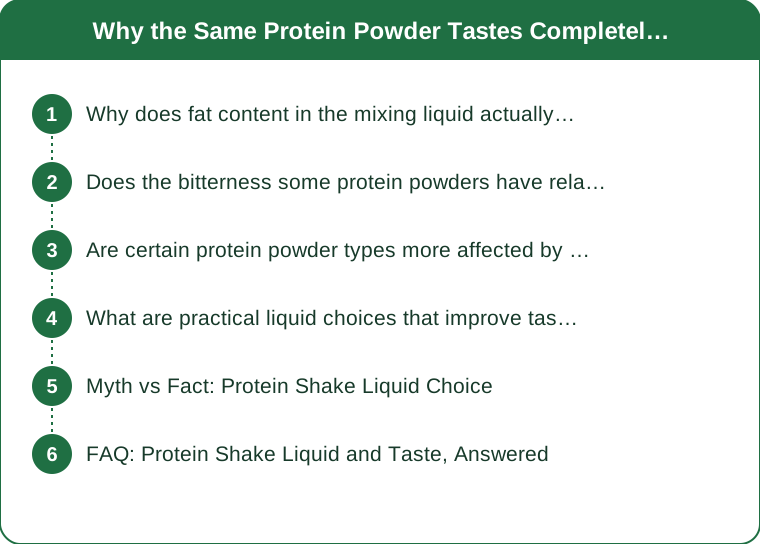
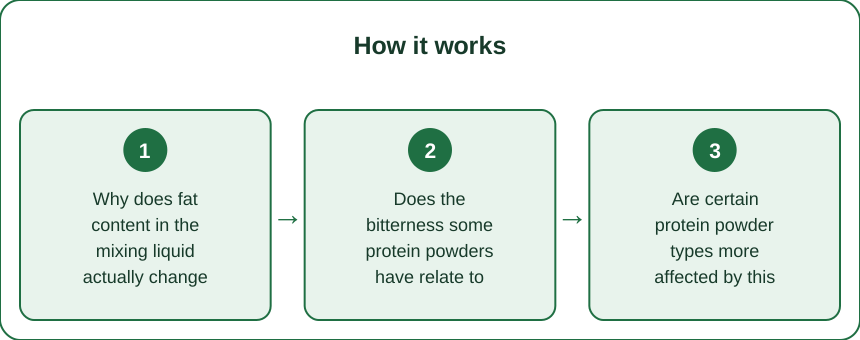
Why does fat content in the mixing liquid actually change how a protein shake tastes, chemically?
Many flavor compounds, particularly in artificial and natural flavoring systems, are fat-soluble, meaning they bind to and are carried more smoothly by fat molecules, producing a rounder, less sharp flavor perception. Water has no fat to carry these compounds, so the same flavoring can taste more concentrated, artificial, or bitter, since nothing is buffering or smoothing its perception on the palate.
Does the bitterness some protein powders have relate to this same liquid-choice issue?
Partially — concentrated protein, particularly whey and plant-based isolates, has some inherent bitterness from the amino acid and processing profile itself, and sugar or lactose from milk masks this underlying bitterness more effectively than water does, since sweetness perception can meaningfully suppress bitterness perception when both are present together. This is why the same protein source can taste notably more bitter mixed with plain water than with milk.
Are certain protein powder types more affected by this liquid-choice sensitivity than others?
Yes — plant-based protein blends (pea, rice, hemp) tend to have a more pronounced inherent bitterness and chalkiness than whey isolate, making them generally more sensitive to liquid choice for palatability. Whey protein isolate, being relatively more neutral to begin with, tends to hold up reasonably well even mixed with just water, compared to many plant-based blends.

What are practical liquid choices that improve taste without adding excessive calories, for those avoiding regular milk?
Unsweetened almond or oat milk provides some fat content without milk’s full calorie and sugar load, offering a meaningful taste improvement over water while keeping added calories modest. A small amount of nut butter or a splash of coconut milk blended into a water-based shake can also round out flavor for those wanting to stay closer to a water base most of the time.
Myth vs Fact: Protein Shake Liquid Choice
Myth: A protein powder that tastes bad with water is simply a lower-quality product. Fact: Most protein flavor formulations assume some fat or sugar from the mixing liquid, so water alone often unfairly disadvantages even well-formulated powders.
Myth: Liquid choice only affects taste, not the shake’s nutritional profile. Fact: Liquid choice meaningfully changes total calories, added sugar, and fat content, so it’s a nutritionally relevant decision, not a purely flavor-based one.
FAQ: Protein Shake Liquid and Taste, Answered
Does blending versus shaking with a shaker bottle change how a protein shake tastes?
Blending, particularly with ice, tends to produce a smoother texture and can improve perceived taste even with the same liquid, since it more thoroughly incorporates the powder and reduces clumping.
Is it worth trying a small amount of a flavor booster (cocoa powder, vanilla extract, cinnamon) with a water-based shake?
Yes — a small amount of a complementary flavor booster can meaningfully mask water-based bitterness for relatively few added calories, making it a practical middle-ground option.
Do unflavored protein powders have this same liquid-sensitivity issue?
Unflavored powders generally have less added flavoring to be thrown off by liquid choice, though they still carry some inherent bitterness that milk or a milk alternative helps soften more than water alone.
TL;DR:
- Protein flavor formulations often assume some fat and sugar from the mixing liquid to round out taste
- Fat-soluble flavor compounds are carried and smoothed more by milk or milk alternatives than by water
- Plant-based protein blends tend to be more liquid-sensitive for taste than whey isolate
- Unsweetened milk alternatives offer a taste improvement over water without milk’s full calorie load
A protein shake tasting worse with water reflects a real, explainable flavor chemistry gap, not a product flaw — choosing the right liquid for a specific powder closes that gap without much extra effort.
Keep Reading
This article is for general informational purposes only and is not medical advice. Always consult a qualified health professional for guidance specific to you.