Why Your Protein Needs Change in the Weeks You Sleep Badly
Quick Answer: Short sleep reduces muscle protein synthesis, raises cortisol, and shifts your body toward breaking down more protein than it builds. Studies of restricted sleep show that higher protein intake partially — not fully — offsets the loss of lean mass. During a bad-sleep stretch, nudging protein toward the higher end of your range and spreading it more evenly through the day is a sensible hedge, but it is not a substitute for the sleep.
Same training, same food, same body weight. Two weeks of bad sleep in and your recovery is worse, your strength is flat, and you feel like you are losing ground.
Sleep is a protein variable, not just an energy one. The processes that turn dietary protein into repaired tissue happen largely while you are asleep.
Here is what changes, and what the higher-protein hedge does and does not fix.

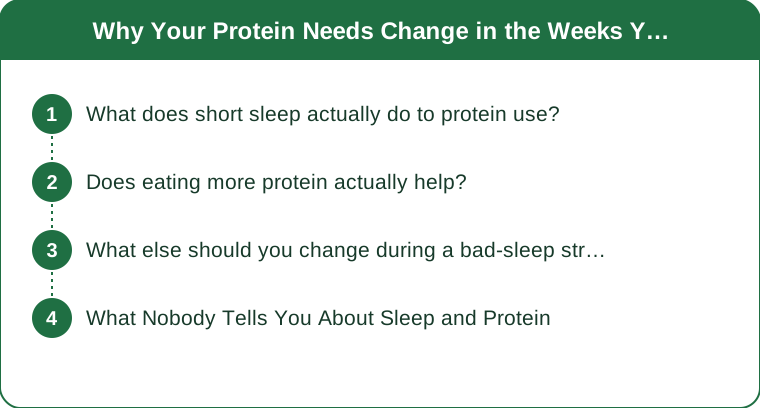
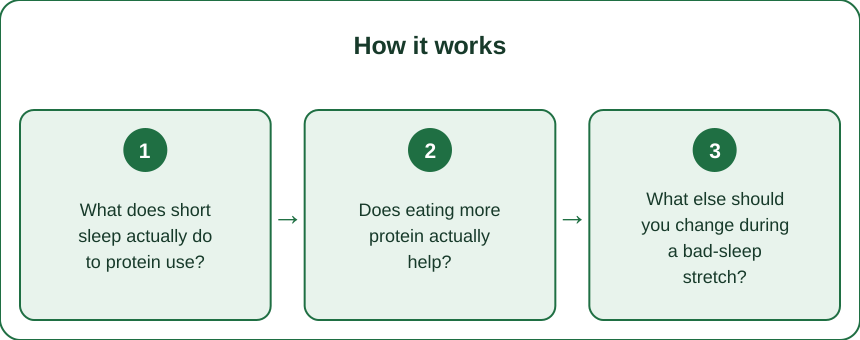
What does short sleep actually do to protein use?
It tilts the balance between building and breaking down, in the wrong direction.
Muscle protein synthesis falls. Controlled sleep-restriction studies show reduced rates of muscle protein synthesis compared with normal sleep, even with matched food intake and training. The building side of the equation slows down.
Breakdown signals rise. Sleep restriction elevates cortisol, particularly in the evening, and shifts the hormonal environment toward catabolism. You get less building and more breakdown at the same time.
Body composition changes even at the same calories. In studies restricting sleep during a calorie deficit, a greater share of the weight lost came from lean mass rather than fat compared with well-rested conditions. Same deficit, worse composition outcome.
And your appetite works against you. Short sleep reliably increases hunger and pushes food choices toward faster carbohydrates, which often means protein intake drops precisely in the week it matters most. The intake you think you are hitting is frequently not the intake you actually hit during a bad sleep stretch.
Does eating more protein actually help?
Partially. It is a real hedge and it is not a fix.
The research shows attenuation, not prevention. Higher protein intakes during sleep restriction reduce the loss of lean mass relative to lower intakes, but do not eliminate it. Useful, and worth doing — not a replacement for sleeping.
A practical range. For most people training regularly, 1.6 to 2.2 g per kg of body weight per day covers the evidence base. During a poor-sleep stretch, moving toward the upper part of your usual range is a reasonable adjustment.
Distribution matters more when synthesis is impaired. Three or four servings of roughly 25 to 40 g spread across the day stimulate synthesis more effectively than the same total in one or two large meals. When the machinery is already blunted, giving it more opportunities helps.
Do not overshoot. Going well beyond about 2.2 g/kg has not shown additional benefit for most people, and it tends to crowd out carbohydrate — which you need more of, not less, when you are tired and training.

What else should you change during a bad-sleep stretch?
Lower the training demand slightly, protect your carbohydrate intake, and keep protein steady rather than heroic.
Cut training volume before you cut training. Reducing sets by roughly a third while keeping intensity and frequency preserves the stimulus with much less recovery cost. Stopping entirely is rarely the best answer for a week or two.
Keep carbohydrate up. Sleep-deprived training feels harder partly because of impaired glucose handling. Cutting carbs at the same time compounds the problem.
Do not start a calorie deficit here. Sleep restriction plus a deficit is the specific combination that costs you lean mass. If you are choosing when to diet, this is not the window.
Front-load protein a little. Appetite dysregulation tends to hit hardest in the evening. Getting 30 to 40 g at breakfast makes the day’s total far more likely to be reached. The single most effective change for most people is a protein-forward breakfast, which is also the meal that bad sleep most often turns into coffee alone.
What Nobody Tells You About Sleep and Protein
A single bad night is not the issue. The measurable effects show up over consecutive nights of restriction. One rough night is noise; two weeks is a pattern worth adjusting for.
Pre-sleep protein is genuinely supported. A serving of 30 to 40 g of slower-digesting protein — casein, dairy, or a mixed meal — before bed increases overnight muscle protein synthesis. It is one of the few timing interventions with reasonable evidence behind it.
Training still helps. Resistance training remains protective for lean mass during sleep restriction. Do not skip it out of a sense that you cannot recover — just reduce the volume.
Alcohol stacks with this badly. It fragments sleep architecture and independently blunts muscle protein synthesis. During a bad-sleep stretch it is the highest-value thing to drop.
Protein cannot buy you sleep. It is worth stating plainly: the intervention with the largest effect size here is going to bed earlier. Everything in this article is what you do when that is genuinely not available.
This is general information, not medical advice. Persistent insomnia or daytime sleepiness is worth discussing with a healthcare professional.
TL;DR:
- Short sleep lowers muscle protein synthesis and raises breakdown signals, so the same intake builds less.
- In a calorie deficit, poor sleep shifts more of the weight lost toward lean mass.
- Higher protein partially offsets the loss — move toward the upper end of 1.6 to 2.2 g/kg, spread across 3 to 4 servings of 25 to 40 g.
- Protect carbohydrate, cut training volume by about a third rather than stopping, and avoid starting a deficit during a bad-sleep stretch.
- A protein-forward breakfast and 30 to 40 g of slow protein before bed are the two highest-value timing changes.
- Alcohol compounds the problem; sleep itself remains the intervention with the biggest effect.
The useful reframe is that protein is a hedge against bad sleep, not a substitute for it. Adjust intake and volume for the stretch you are in, and treat the sleep itself as the thing you are actually trying to fix.
Keep Reading
This article is for general informational purposes only and is not medical advice. Always consult a qualified health professional for guidance specific to you.