Why How You Cook Protein Changes How Much You Actually Absorb
Quick Answer: Cooking generally improves protein digestibility by unfolding proteins so digestive enzymes can reach them — cooked egg protein is absorbed at around 90 percent versus roughly 50 percent raw. But very high heat and prolonged cooking can go the other way, forming compounds that reduce the availability of some amino acids, particularly lysine. The practical target is cooked through with moderate heat and moderate time, which is what most ordinary home cooking already does.
The differences are real and modest. They matter most for people eating at the edge of their protein needs, not for people comfortably over target.

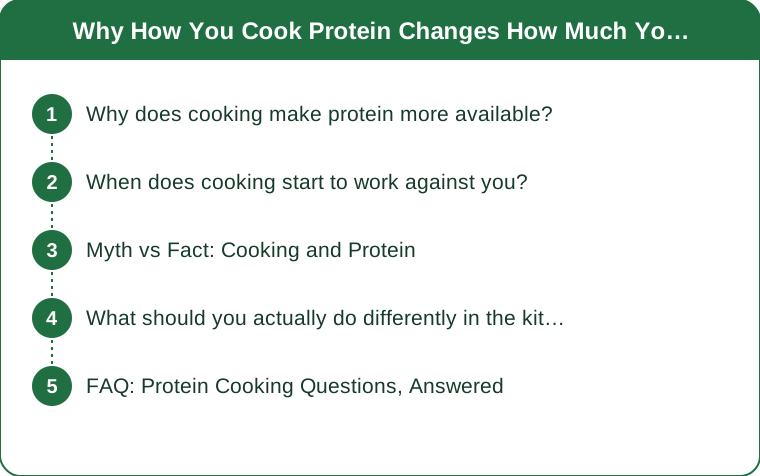
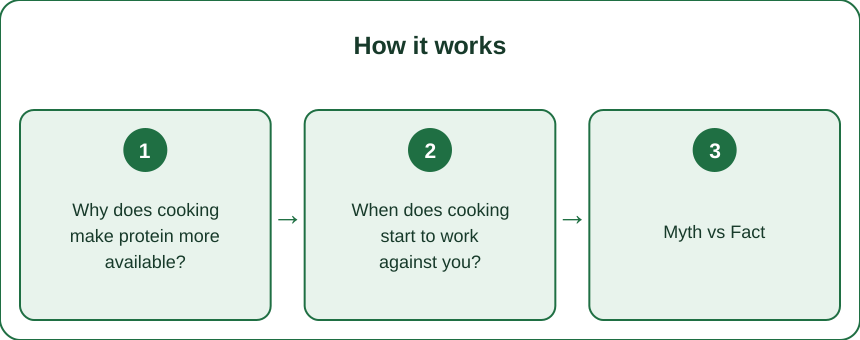
Why does cooking make protein more available?
Because raw protein is folded up, and digestive enzymes work on the outside.
Proteins in food are long chains folded into compact three-dimensional shapes. Your digestive enzymes — pepsin in the stomach, trypsin and others in the small intestine — cut those chains at specific points. They can only cut at points they can physically reach, and in a tightly folded protein most of the chain is buried inside.
Heat denatures protein, which means it unfolds those structures. The chain becomes accessible along its length, and enzymes can work far more efficiently.
The egg is the clearest example because it has been studied directly. Protein from a cooked egg is absorbed at roughly 90 percent; from a raw egg, closer to 50 percent. That is not a marginal difference — it is nearly double.
There is a second mechanism in some foods. Raw egg white, raw legumes, and raw soy contain enzyme inhibitors — compounds that actively interfere with digestive enzymes. Cooking deactivates them. This is why raw legumes are both hard to digest and, in some cases, genuinely unsafe.
Plant proteins get an additional benefit. Cooking softens cell walls, and much of the protein in legumes and grains sits inside cell structures that human digestion cannot break open efficiently. Heat does the opening, which is a substantial part of why cooked legumes contribute far more usable protein than raw ones.
So the first-order answer is simple: cooked beats raw, for nearly every protein source, by a meaningful margin.
When does cooking start to work against you?
At high temperatures, for long durations, and especially where sugars are present.
The main mechanism is the Maillard reaction — the browning chemistry that creates the crust on a steak and the color on toast. It is responsible for a large share of the flavor in cooked food, and it works by bonding amino acids to sugars.
The amino acid most affected is lysine, because its chemical structure makes it particularly available for this reaction. Lysine bound into a Maillard compound is not released by digestion, so it is effectively lost.
This matters more in some contexts than others. Lysine is the limiting amino acid in grains, so heavily browned grain-based foods lose more of a nutrient they were already short on. For meat, eggs, and dairy, which are lysine-rich, the loss is proportionally less consequential.
There is a second effect at very high heat and long duration. Extreme heat can cause protein cross-linking, where chains bond to each other in ways that resist enzymatic breakdown. This is part of why a well-done, long-cooked piece of meat is both tougher and somewhat less digestible than the same cut cooked gently.
How big are these losses in practice? Generally in the range of a few percent to perhaps 10 to 15 percent of specific amino acids under harsh conditions, not a wholesale loss of the protein. Nobody is cooking away half their steak.
The honest summary: the gain from cooking raw to cooked is large. The loss from cooking gently to cooking harshly is small. If you are optimizing, the first one is where the value is.

Myth vs Fact: Cooking and Protein
Myth: Raw eggs are better for building muscle. Fact: The opposite, by a wide margin. Cooked egg protein is absorbed at roughly 90 percent against about 50 percent raw. Raw egg white also contains avidin, which binds biotin. Cooking solves both.
Myth: Cooking destroys protein. Fact: Cooking denatures protein, which is not destruction — it is unfolding, and it makes protein more available, not less. Denatured protein contains the same amino acids.
Myth: Microwaving damages protein more than other methods. Fact: Microwaving is generally gentler than high-heat pan searing or grilling, because it heats faster with less surface browning. It is one of the better methods for protein retention, not one of the worse.
Myth: Grilling is the healthiest way to cook meat. Fact: Grilling produces high surface temperatures and heavy browning, which is where the amino acid losses and other high-heat compounds concentrate. It tastes excellent. It is not the gentlest option for protein.
Myth: Protein powder is degraded by adding it to hot liquid. Fact: Heat denatures it, which is the same thing that happens in your stomach anyway. It may change texture and clump, and the amino acids remain fully available.
Myth: Boiling meat leaches out the protein. Fact: Some protein and amino acids move into the cooking liquid, which is why stock is nutritious. If you consume the liquid, nothing is lost. If you discard it, you lose a small amount.
What should you actually do differently in the kitchen?
Five adjustments, none of them demanding.
Cook protein through, but not aggressively. Moderate heat, cooked to a safe internal temperature, and off the heat. This captures nearly all of the digestibility gain with essentially none of the high-heat loss.
Use the liquid. If you poach, braise, or simmer, the cooking liquid contains protein and amino acids. Making it into a sauce, a soup base, or a gravy recovers what would otherwise go down the drain.
Soak and properly cook legumes. Soaking reduces cooking time and helps with the compounds that interfere with digestion. Properly cooked beans and lentils deliver substantially more usable protein than undercooked ones, and undercooked legumes are also the ones that cause digestive complaints.
Do not fear a gentle scramble. Eggs cooked gently to just set are at the ideal point — fully denatured, minimally browned. A hard-browned omelette is not a problem, and it is slightly less optimal.
Reheat gently. Repeated high-heat reheating of the same protein compounds the effect. For meal prep, this argues for reheating at lower power for longer rather than blasting it.
One seasonal note worth making. As cooking shifts toward autumn methods — braises, stews, slow-cooked dishes — the protein picture actually improves. Long, low, wet cooking is gentle on amino acids, and the liquid is part of the dish rather than discarded. The summer methods that are heaviest on protein are the high-heat grilling ones. That is not a reason to skip the grill, and it is a small point in favor of the season’s cooking.
This is general nutrition information, not medical advice. Always cook foods to safe internal temperatures — food safety outranks any of the marginal differences discussed here.
FAQ: Protein Cooking Questions, Answered
Does this change how much protein I should aim for?
Not meaningfully. Standard protein targets are based on studies of people eating normally cooked food, so the digestibility of ordinary cooking is already baked into the recommendation.
Is well-done steak significantly worse for protein?
Slightly less digestible and slightly lower in some amino acids than a medium steak. The difference is small enough that cooking meat the way you enjoy it is the reasonable choice.
What about plant proteins specifically?
Cooking helps them more than it helps animal proteins, because it breaks down cell walls and deactivates enzyme inhibitors. If you eat mostly plant protein, thorough cooking of legumes and grains is the highest-value habit on this list.
TL;DR:
- Cooking unfolds protein so enzymes can reach it — cooked egg absorbs at about 90 percent versus roughly 50 percent raw.
- Very high heat and heavy browning bind some amino acids, especially lysine, but the losses are modest.
- Moderate heat cooked through is the sweet spot, and using the cooking liquid recovers what leaches out.
- Plant proteins benefit most from thorough cooking, because heat opens cell walls and deactivates enzyme inhibitors.
The gain from cooking raw to cooked is large; the loss from gentle to harsh is small. Get the first one right and stop worrying about the second.
Keep Reading
This article is for general informational purposes only and is not medical advice. Always consult a qualified health professional for guidance specific to you.