Does It Actually Matter If You Drink Your Protein Shake Before or After a Workout?
Quick Answer: Research over the past decade has consistently shown the strict post-workout ‘anabolic window’ is much wider and more forgiving than earlier fitness advice suggested — total daily protein intake matters far more than whether a shake is consumed exactly before or after a session, though having protein reasonably close to training (within a few hours either direction) still supports recovery well.
The pre-versus-post debate has largely settled: it matters much less than total daily intake does.

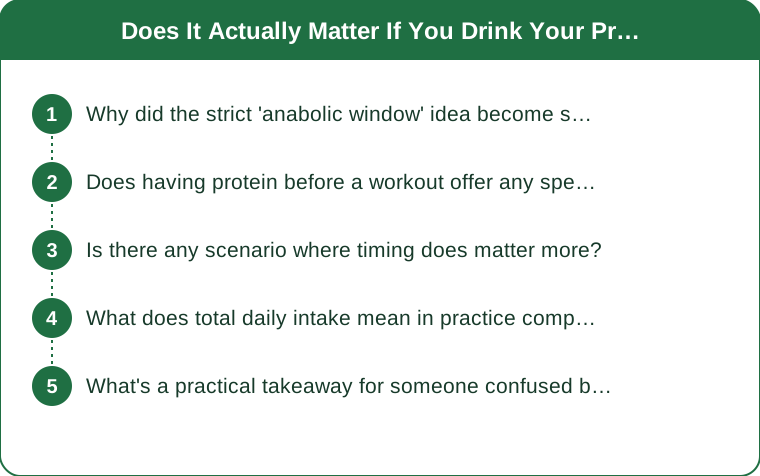
Why did the strict ‘anabolic window’ idea become so popular?
Early research on rapid muscle protein synthesis after training led to widely repeated advice about consuming protein within a narrow 30-60 minute post-workout window, but later, more rigorous studies found that window is considerably wider than originally claimed, and the urgency around hitting it precisely wasn’t well supported by the actual data.
Does having protein before a workout offer any specific advantage?
Some research suggests pre-workout protein can provide amino acids already circulating during and shortly after training, which may support muscle protein synthesis similarly to post-workout timing — meaning ‘before’ isn’t a worse choice than ‘after,’ just a different point in a wider effective window.

Is there any scenario where timing does matter more?
For someone training fasted after a long period without protein intake, having protein reasonably close to the session (before or after) likely matters more than for someone who ate a protein-containing meal a couple hours prior, since total recent intake — not just timing around the workout itself — is the more relevant variable.
What does total daily intake mean in practice compared to timing?
Spreading adequate total protein across three to four meals throughout the day has a bigger measurable impact on muscle protein synthesis and recovery over time than optimizing the exact minute of a single pre- or post-workout shake, according to most current research on the topic.
What’s a practical takeaway for someone confused by the noise around this topic?
Having a protein-containing meal or shake sometime within a few hours of training, in either direction, while making sure total daily protein needs are met, covers what the current research actually supports — without needing to stress over precise timing to the minute.
TL;DR:
- The strict post-workout anabolic window is more forgiving than earlier advice suggested
- Pre-workout protein timing appears roughly comparable to post-workout timing
- Fasted training may make timing slightly more relevant than well-fed training
- Total daily protein intake matters more than optimizing a single shake’s timing
The pre-versus-post question has largely been settled — total daily intake is the bigger lever.
Keep Reading
This article is for general informational purposes only and is not medical advice. Always consult a qualified health professional for guidance specific to you.