Why Protein Fills You Up More When You're in a Calorie Deficit Than at Maintenance
Quick Answer: Protein’s satiety effect is partly driven by hormones like ghrelin (hunger) and peptide YY and GLP-1 (fullness), and research suggests these hormonal responses to protein can be more pronounced when someone is in a calorie deficit than at maintenance, likely tied to the body’s heightened hunger-signaling state during energy restriction — meaning the same gram-for-gram protein intake may genuinely feel more satiating while dieting than it does at a stable maintenance intake.
If 30 grams of protein felt dramatically more satisfying during a cut than the same 30 grams did at maintenance, that’s not inconsistency — it lines up with how the body’s hunger and fullness hormones actually behave differently depending on overall energy balance.

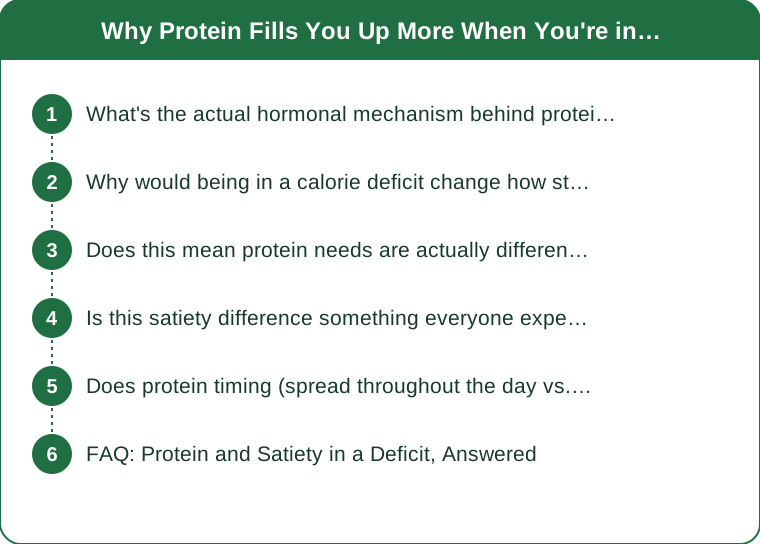
What’s the actual hormonal mechanism behind protein’s satiety effect generally?
Protein intake triggers the release of satiety-related hormones including peptide YY and GLP-1, while also more effectively suppressing ghrelin, the primary hunger-signaling hormone, compared to equivalent calories from fat or carbohydrate — this combination of increased fullness signaling and reduced hunger signaling is the core reason protein is consistently rated as the most satiating macronutrient across a wide body of research.
Why would being in a calorie deficit change how strongly that hormonal response shows up?
A sustained calorie deficit is associated with elevated baseline ghrelin levels and generally heightened hunger-regulation sensitivity, since the body is responding to reduced overall energy availability — against that backdrop, protein’s hunger-suppressing effect may register as more noticeable or impactful specifically because there’s more baseline hunger signal for it to counteract, compared to a maintenance state where hunger signaling is already comparatively more stable.
Does this mean protein needs are actually different during a deficit versus maintenance, not just how filling it feels?
Many nutrition guidelines do recommend somewhat higher protein intake relative to total calories during a deficit specifically, partly for this satiety benefit and partly to help preserve lean mass during calorie restriction — so the enhanced filling effect during a deficit lines up with, and partly explains, why protein recommendations already tend to shift upward as a proportion of intake when calories are reduced.

Is this satiety difference something everyone experiences to the same degree?
Individual variation is significant — factors including baseline hormone sensitivity, sleep quality, stress levels, and the specific protein source and amount all influence how strongly this effect is experienced, so while the general hormonal mechanism is well-supported, the subjective magnitude of ‘protein feels more filling while dieting’ can vary meaningfully from person to person.
Does protein timing (spread throughout the day vs. concentrated in fewer meals) change this deficit-related satiety effect?
Some research suggests spreading protein intake more evenly across meals may support more consistent satiety signaling throughout the day than concentrating most protein into one large meal, which is a separate consideration from the deficit-versus-maintenance question but interacts with it — evenly distributed protein during a deficit may compound the satiety benefit somewhat more than a lopsided distribution would.
FAQ: Protein and Satiety in a Deficit, Answered
Does this mean protein should make up close to 50% of calories during a deficit?
Not necessarily — many evidence-based recommendations for a deficit fall in a range that increases protein’s proportion of total calories without requiring it to be the dominant macronutrient; individual needs vary and a nutrition professional can help tailor this.
Does this satiety effect fade the longer someone stays in a deficit?
Some adaptation in hunger hormone response over a prolonged deficit is documented, so the pronounced early satiety benefit may soften somewhat over many weeks, which is part of why diet breaks are sometimes recommended for longer cuts.
Is plant protein as effective for this satiety effect as animal protein?
Most research suggests the satiety-related hormonal response is driven primarily by total protein and amino acid content rather than source, so a well-planned plant-based intake can produce a comparable effect to animal protein at similar total protein amounts.
TL;DR:
- Protein’s satiety effect works through hormones like ghrelin, peptide YY, and GLP-1
- A calorie deficit is linked to elevated baseline hunger signaling, which protein’s effect works against more noticeably
- Higher protein-to-calorie ratios during a deficit align with, and partly explain, this enhanced satiety benefit
- Individual variation, protein timing, and adaptation over time all still shape how strong this effect feels
The extra-filling feeling from protein during a cut isn’t in your head — it’s your hunger hormones and your protein intake working against a genuinely different baseline than they are at maintenance.
Keep Reading
This article is for general informational purposes only and is not medical advice. Always consult a qualified health professional for guidance specific to you.