Why Counting Protein Grams Alone Misses Half the Actual Picture
Quick Answer: Protein quality — how complete the amino acid profile is and how digestible the source is — determines how much of a labeled gram count your body can actually use, which is why 20 grams from one source isn’t always equal to 20 grams from another.
Gram totals are the easiest number to track, which is exactly why so many people stop there and miss the quality half of the equation entirely.

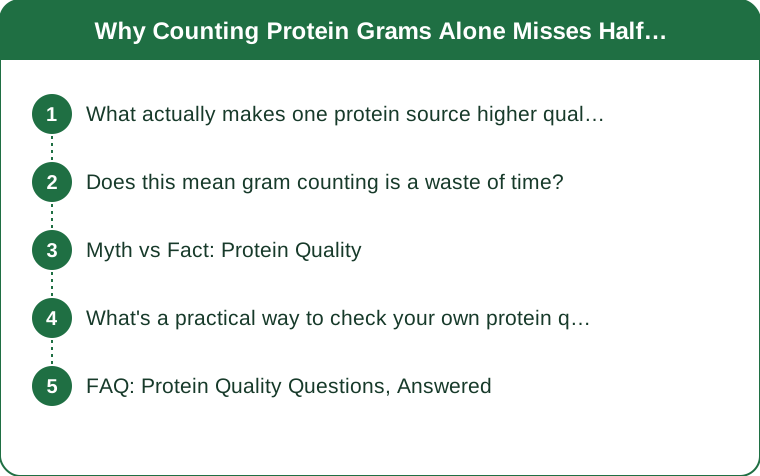
What actually makes one protein source higher quality than another?
A high-quality protein contains all nine essential amino acids in reasonably close to the proportions the body needs, and is efficiently digested and absorbed — animal proteins and soy generally check both boxes, while many individual plant proteins are missing or low in at least one essential amino acid.
This doesn’t mean plant-based eating can’t hit high-quality protein targets — it usually just means combining sources (like grains with legumes) across the day to cover what any single plant source is missing.
Does this mean gram counting is a waste of time?
No — gram totals still matter and remain the most practical daily tracking tool for most people. The quality piece is more about occasionally checking whether your protein sources are varied enough to cover amino acid gaps, not about abandoning gram tracking altogether.
For most people eating a reasonably varied diet with at least some animal protein, dairy, or soy, quality gaps are rarely a real-world problem — it becomes more relevant specifically for those eating an exclusively plant-based diet without much variety.

Myth vs Fact: Protein Quality
Myth: plant protein is inherently lower quality than animal protein. Fact: individual plant sources often lack one amino acid, but combining varied plant sources across the day closes that gap just as effectively as animal protein does.
Myth: you need to precisely combine complementary proteins in the same meal. Fact: the body maintains an amino acid pool across the day, so eating varied protein sources at different meals works just as well as combining them in a single dish.
What’s a practical way to check your own protein quality?
Looking at a typical day and asking whether protein sources are varied — some animal, dairy, or soy, or a mix of grains and legumes if fully plant-based — is a far more useful check than trying to calculate amino acid scores by hand.
If a day’s protein comes from a single narrow source repeated meal after meal, that’s the specific pattern worth diversifying, regardless of how high the gram total looks.
FAQ: Protein Quality Questions, Answered
Do protein powders vary in quality the same way whole foods do?
Yes — whey and soy protein powders are generally considered high quality, while some single plant-based powders (like plain rice protein) may be missing an amino acid unless blended with another source.
Is eating too much protein of any quality a concern?
For most healthy adults, moderately high protein intake isn’t a concern, though anyone with kidney issues should discuss protein levels with a doctor specifically.
Does cooking method affect protein quality?
Cooking generally doesn’t reduce protein quality meaningfully and can even improve digestibility for some plant proteins by breaking down anti-nutrients that interfere with absorption.
TL;DR:
- Protein quality (amino acid completeness and digestibility) affects how much of a gram count your body actually uses
- Gram tracking is still useful — quality is the second layer, not a replacement
- Varied plant sources across the day cover amino acid gaps just as well as single high-quality sources
- Check for variety in your typical day rather than calculating exact amino acid scores
Keep tracking grams, but glance at variety too — that’s the part gram counts alone can’t tell you.
Keep Reading
This article is for general informational purposes only and is not medical advice. Always consult a qualified health professional for guidance specific to you.